Wednesday, July 28, 2010

Mon party’s campaign dogged by government surveillance

July 28th, 2010

AMRDP chairman Nai Ngwe Thein addresses an audience in Moulmein during the party’s election campaign

Kong Janoi, IMNA : Representatives from the All Mon Regions Democracy Party (AMRDP) are finding that Burmese government surveillance measures are stifling their campaign activities.

According to IMNA field reporters, AMRDP leading organizers Nai Nwe Soe and Nai Baya Aung Moe are being closely monitored by a regional Military Intelligence Unit this week during their campaign in Myiek Township, Tenasserim Division. Witnesses from around Mon State report that that all AMRDP representatives have been followed by the Military Intelligence office in every Township they visit during their campaign, which began in late June.

The party has reportedly been troubled by the Burmese Election Commission’s requirement that all campaign activities be reported to the Commission in advance.

“Last week, when they [AMRDP campaigners] were organizing people in Mudon town, they faced a problem with authorities because they [the AMRDP] informed the [Election] Commission that they would give a speech with two people. In the campaign meeting, when the audience asked a question of their party, one of their members, whose name had not been given to the authorities, talked to the public, so the authorities gave a warning to their party,” a Mudon town witness reported.

“I would like to ask them why pro-junta party like Union Solidarity and Development and Ethnic Unity Party is free to do anything without any restriction from the government,” he added.

Despite pressure from Burma’s military regime, Nai Ngwe Thein, the leader of the AMRDP, believes that the party will ultimately be successful in gaining votes in Mon State.

“We will definitely win the [parliamentary] seat in Mon State if there are free and fair elections, because as far as we know, many people don’t like the pro-junta party. People will only vote to pro-junta party if they feel a threat [from the Burmese government]. We have to explain our people not to afraid to vote to our party,” he explained to IMNA’s field reporters in an interview this month.

According to IMNA field reporters observe situation in Mon State, many people are increasingly enthusiastic about casting their votes in favor of the AMRDP.

Nai Tun, a resident of Mudon Township, said, “Although we see this election is not fair, when the Mon party will come up for elections in our region, we will vote for them because our votes will go only for the Mon Party which we believe will care for our people.”

A political observer from Rangoon named Nai Htaw Mon explained to IMNA that even one member of the AMRDP in Burma’s parliament will likely increase the Mon people’s cultural rights.

“If we look at the Mon culture and literature aspect, it will be freer to learn and teach after the election [if even one AMRDP member is elected]. Politically speaking, if the Mon Party will properly get elected at last, with ten members, what they can do is be a voice in parliament with that amount of people.”

The AMRDP was formed in April 2010; the group is currently the only Mon political group campaigning in Mon State and Mon-controlled areas in the 2010 Burmese elections.

Tuesday, July 27, 2010

Shanghai Expo Shows off China’s Green Technology Effort


E-mail Print PDF


Download Innovative clean technology is the focus of Shanghai Expo 2010.

Solar energy, wind power, and nuclear energy are being promoted to the expected 70 million visitors to the Expo.

Many green technologies, especially energy saving home appliances, are on display which hopefully will benefit the Chinese city’s environment long after the event has closed.

Banyar Kong Janoi has a story from Shanghai.

Shuttle buses running on solar power move people around the giant Expo.

In the Chinese pavilion a film on how to make a city more environmentally friendly is showing.

Wind power, solar and nuclear energy technology are demonstrated to visitors.

A Shanghai resident, Xie Jing-hu, says he has seen changes for the better in his city.

“You see this from the cleaning-up of Suzhou river and the city tree planting program. Natural gas has also replaced coal gas in many areas which is cleaner and more environmentally friendly.”

Shanghai is one of China's most populous cities and one of the world's major ports.

The city's infrastructure and environmental problems include housing shortages and air and water pollution.

Heavy dependence on coal as a source of fuel for both industrial energy and residential heating in Shanghai has resulted in significant air pollution.

Also, a daily flow of approximately four million cubic meters of untreated human waste enters the Huangpu River creating serious water pollution.

But Shanghai resident, Xie Jing-hu, says the government is now putting pressure on industry to be cleaner.

“Factories that do not pay attention to the environmental protection laws are shut down. So now businesses have to solve the pollution problem. Rubbish is recycled to create electricity. We can only expect and we also believe that things will get better.”

According to officials since the Expo opened on May 1, the solar power station inside the zone has generated 1.2 million kilowatt-hours of power.

Water cooling technologies have saved nearly six million kilowatt-hours of power on air conditioning.

Lin Bin is a deputy Director of Jiefang Daily Group, a communist founded newspaper.

“People are concerned about green technology because it’s about their quality of life. But they also think about money. So there needs to be a balance between greenness and economic development.”

China is the world's leading manufacturer of solar panels.

But 95 percent of these are exported.

Dao Thi Thu Hang from Green Generation Network in Vietnam says China is a role model for the region.

“China is very good example of renewable energy development because China has very good policy to support business and other sectors to develop renewable energy. And I know today China is one of the leading countries in clean technology include clean energy.”

Earlier this year, the Chinese government announced over 100 billion US dollars in incentives for solar power businesses.

According to 2007 government figures, about 17 percent of China's electricity comes from renewable sources.

The country makes heavy demands on hydroelectricity with the largest number of dams in the world and more are being planned.

This hydropower is also being imported from neighboring countries such as Burma and Laos.

Nai Tiaung Pakao is a spokesperson for Mon Youth Progressive Organization, which is campaigning to boycott dams projects in Burma.

“It is good that China is planning to produce wind power and solar energy but at the same time, China invests a lot of money in hydropower plants in Burma. These not only destroy the environment but also create human rights abuses. For instance, when China wants to build a dam in Burma many people are forced from their homes. No one listens to their protests and there are no social or environmental assessments done.”

Back at the Shanghai Expo a school teacher from Beijing, Matt Moar, says China needs to play a positive role in reducing green house gases globally.

“Chinese government started on the green energy and green economics. We are very interesting to see what they do because they contribute a lot of pollution and they have not done so far, have not been really cooperative with the talks and green movement so we will see what they put on the spot.”

He said the Chinese green campaign in the Expo is a step forward.

“There are a lot of countries who don’t really know and are not concerned about recycling or new methods of energy. They are expecting a lot of people at the expo so many people will be educated about this.”

Monday, July 26, 2010

Burma Election Split Pro-democracy Groups

E-mail Print PDF

Download A breakaway group from Burma's pro-democracy party the National League for Democracy (NLD) has been registered to run in elections due later this year.

The National Democratic Force's decision to run in the controversial elections has put it at odds with other supporters of the NLD.

Traditional pro-democracy leaders, led by Aung San Suu Kyi, refused to register the NLD for the poll.

As a result, the party was disbanded by the military authorities.

Banyar Kong Janoi in Rangoon hears the arguments from both sides.

In one of the cities most popular tea houses a group of men are having a heated discussion about the upcoming election.

Some believe it’s right that pro-democracy groups are joining the poll while others believe it’s a betrayal of the movement.

I take them to safe place to record their views.

Htaw Mon is a car broker in Rangoon.

He agrees with the National League for Democracy (NLD) decision to boycott the election.

“Even if the opposition wins half the seats in parliament they won’t have a chance to change anything. In order to make any decision, 75 percent of the members of parliaments have to agree. Besides, 25 percent of the seats automatically go to members of the military and we don’t know how many seats the pro-junta party will get. So the election means nothing.”

The NLD won a landslide victory in Burma's last elections in 1990, but the country's military rulers have refused to hand over power.

Aung Suu Kyi has spent most of the last two decades in some form of detention and she is currently under house arrest despite strong international pressure.

Her party has decided to boycott this years election to send a strong message that the new constitution and the poll is a sham.

U Aung Thein is a member of central executive committee of NLD.

“The 2008 constitution is to entrench the military regime. It is also against democratic principles. What’s more, if we look at the right of ethnicities, this constitution seems like federalism, in fact it’s not because the presidents and prime ministers have to be members of the military. So it is very hard for ethnic people to get a high position like prime minster. That’s why it is not democracy so we cannot accept it.”

NLD is demanding the military government change the constitution and make the polls free and fair.

U Aung Thein says they are ready to take-part if that happens.

“We want to change electoral laws. The constitution should be redrafted and the dialogue should be called among the political parties and ethnic groups for national reconciliation. The election commission should not be controlled by any political party. Now as the election commission has to dance for junta, how they can do their job freely? How could we take part in the election under these circumstance?”

But not all pro-democracy activists agree.

The NLDs decision not to re-register to contest in this year’s election put it at odds with some of its supporters.

So they formed a break-away party called the National Democratic Force.

U Khin Maung Swe is the leader of the party. I spoke to him on the phone as it was too dangerous for us to meet in person.

“We know this is not going to be a fair election but we have to move on from that. If we have legislature power we can act as a check and balance to the government. If we just say “The election is not free or fair” and boycott it the military government will rule forever. According to constitution if no one challenges the military government they will win.”

He says people need a political party to stand with them.

“Our Burmese people need change. That’s why we want to give them some hope in politics. The political crisis, which they have suffered under for many years, must be solved in the parliament. We need political reconciliation. We believe all democratic forces, ethnic leaders, and the leaders of military who hold 25 percent of parliament’s seats will help turn this country into a democracy in the future.”

News that the new party had received a permit to run in the elections was broadcast on state media.

The state-run Myanma Ahlin newspaper said the National Democratic Force will join 37 other new political parties and five existing groups in contesting the poll.

U Khin Maung Swe says they want to work inside the system to create a socialist liberal democracy.

“We don’t believe our Burmese people can move to the liberal democracy so we will have to go with socialist liberalist democracy as our political setting with mixing market orientated economy. We want to boost people’s economy to increase the number of middle class people in the country.”

NLD supporters have accused the National Democratic Force of stealing their party symbol - a bamboo hat - in order to win votes.

But Khin Maung Swe said his party's symbol is not the same because it has two stars above the hat.

U Aung Thein from the NLD’s central executive committee says this election will only bring about more suffering.

“Only if an elected government is running the country that Burma can be changed. Now the junta is controlling any changes. It could take two or three decades before we see real change into Burma because the military has secured their position in the constitution to avoid facing justice for her violence acts. People have suffered and are suffering a lot.”

But on the streets of Rangoon there is some optimism about the election.

Mi Mow is a high school student in the capital.

“We haven’t seen any election before. It is very exciting to cast our vote. It is good for us to know that we can choose our leader.”

In next week’s program we will be hearing more some the residents of Rangoon about how they are feeling about the election and depsite the fact there is still no date for the poll our reporter takes a lot at the political campaigning that ‘s ready begun before.


Wednesday, June 16, 2010

Chinese funding freed Burma to participate in Shanghai Expo


By Kong Janoi/ Shanghai

The Chinese government has subsidized the pavilions of developing countries to join the 184 Shanghai Expo.

The funding for the otherwise excluded countries comes as the expo also promises to give foreign nations and companies a chance to further develop business partnerships with China and Chinese companies.

A representative of Bangladesh Pavilion, Mohammad Abdul Halim, said they came to the expo through the expo committee arrangement.

“We did not even invest a single penny on this expo. We even get a salary from the expo committee,” he said. “We get a small building here but it is fine for us.”

According to Shanghai Expo official website the Chinese government spent US $58 billion on the Expo and related infrastructures in Shanghai.

Burma, which shares a border with China and tight economic connections, was invited to the expo this year. It is the first time isolated nations, such as Burma, North Korea, Zimbabwe and Iran, are participating in a world expo.

With the theme of the Shanghai Expo being, “A Better City, A Better Life”, these isolated nations, such as Burma, increase exposure for their culture’s heritage and relation to the economy of China.

These countries’ pavilions have not been popular amongst visitors due to the little amount invested on the pavilions and exhibitions. However some people are still coming to see these pavilions because they have had no lines in which to queue as compared to the more popular pavilions where visitors have had to wait several hours.

Inside the Burmese pavilion, a Hong Kong Tourist, Yuen man-yuk reported, “I felt strange when I saw those countries showing tourist-like attractions in the World Expo because I expected to see such hi-tech exhibitions in the Expo and other fascinating new inventions.”

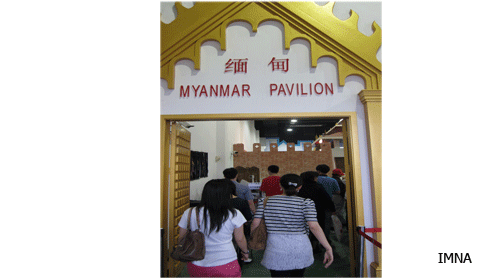
The Burmese pavilion, which is part of the Joint Asia Group III, shares it’s building with Laos. The Burmese theme, entitled “Better Urbanization with Harmonized Eco-System”, is designed like a Mandalay palace inside, and features a hanging picture of Shwedagon pagoda as the background. In the pavilion local customs and culture are introduced. Additionally the pavilion hosts the sales of diamonds and other Burmese products.

However there are no Burmese staff present in the pavilion, compared to other countries have their own staffs to represent their country. Visitors have reported that due to the building’s size and little visual development, the “Better Urbanization with Harmonized Eco-System” takes five minutes visit.

The offer by China to fund Burma’s pavilion is telling, Nyo Ohn Myint, chairperson of the Foreign Affairs Committee for the National League for Democracy Librated Area (NLDLA), believes. Nyo Ohn Myint says that China wants to influence those countries in term of economy and politics.

“China has a lot of border trade [between the] Burmese and Chinese government,” notes Myint. “They want Burmese government to be more efficient and independent economically within the Chinese scope, So they can grow a Chinese economic empire. That is why the Burma [is] invited [to] the Expo.”

Xinhua, a Chinese government controlled news agency, said that China and Burma will sign a series of agreements to boost existing bilateral trade, which reached US $264 million this year.

Burma has faced economic sanctions form the United States and other western countries since 1990 when the ruling military junta refused to acknowledge the results of national election that overwhelmingly elected the opposing party, the National League for Democracy, led by noble laureate Aung San Su Kyi.

Since, the question of sanctions has been increasingly divided, as 20 years later the Burmese military regime remains in power and the Burmese economy remains stagnant.

Myint added, “The Burmese government exports only raw material like timber and some kinds of natural resources. China wants Burma to be more open minded to deal with the world because the sanctions are part of the problem in that Burma cannot co-exist the international economic sector. But that [also makes] China [the] only door for Burmese government to deal with international communities.”

For some visitors that attend the Burmese pavilion at the world expo, the Chinese effort to support Burma’s fledgling pavilion, is an opportunity for awareness. A United States tourist, Matt Maar, said the China effort inviting isolated countries to the Expo is a sign of a new step to solve their problems.

“It is good because isolation is not going to solve the problem. They should be given a chance see and realize [what] benefit there is to open their countries. I think the move by China is on right track.”

Shanghai World Expo: A Better Life?

Sunday, 06 June 2010 14:04 Banyar Kong Janoi

E-mailPrintPDF
Hitssmaller text tool iconmedium text tool iconlarger text tool icon

Download The Chinese government has spent nearly 60 Billion US dollars on it’s World Expo in Shanghai.

It’s on for 184 days and China is using it to show off its remarkable economic growth.

The expo also promises to give foreign nations and companies a chance to further develop business partnerships with China and Chinese companies.

Banyar Kong Janoi is at the Expo for Asia Calling.

Thousands of people are crowded in front of the gate.

Security guards are checking every person. Water and liquid are not allowed in. Notebook computers are scanned.

More than 190 countries and more than 50 international organizations have registered to make this the largest ever World Expo.

China expects almost 100 foreign leaders and millions of people from across the world to come and see the show.

Already there are long queues to get inside the pavilions.

It can take hours to get into popular ones from Japan, Germany, Saudi Arabia and South Korea.

Inside these pavilions, visitors experience the current and future urban life of the country by way of images and videos projected onto screens along the corridors.

Environmental protection is a common theme.

Hi-tech wind power and solar energy models are being promoted. Riding bicycles instead of driving cars is encouraged.

Sailee from Hong Kong has come here to explore new innovation.

“Learn the culture of other countries and also hi-tech. But also some kind of Chinese people and other foreigners”

The African live show is amusing many vistors.

Three black singers in full song interact with the audience.

Many developing countries are taking part in this year’s expo.

Mohammad Abdul Halim is a Bangladesh Pavilion representative.

“We have gained experience visiting different pavilions that how development their economy, history, culture, and even manufacture capacity. Then We can compare with our capacity. We have an opportunity to do how to develop farther in the capacity of Bangladesh so this is the best forum.”

He said the Expo is a symbol of China’s global influence.

“I think it is one of the greatest opportunity for China to show case this power because you know. China is fast forward country. It is going to dominate the world in term of economy. You know China is the pick of economic development: resource mobilization is highest pick so China is showing how powerful the country is economically, technologically, culture heritage all the things."

Halim see China as a role model for Bangladesh and another developing countries.

“Because of China develop in the fastest rate. They are using their resources in the greater way. They are very much environment conscious also. So Bangladesh as a developing country should fellow China on their development activities.”

The Expos theme song ‘a better city a better life’ can be hear throughout the park.

Shanghai resident Li Ping is happy with the rapid development taking place in her city.

“The situation now is far much better than before and definitely this slogan “better city better life” will be realized in the future since the world exposition brings with it advanced knowledge from the developed countries which will facilitate the realization of this version.”

But for some people the Expo has made their life harder.

Over ten thousands families were relocated to other areas to build the Expo.

Even though many of them received compensation, they are still struggling to find somewhere to live due to the soaring property prices.

Standing out side the Expo gates 70 year old, Xie Jing-hu says he has not seen change for the better.

He is a factory worker who rents a small flat with his wife.

“World exposition is organized by the government who takes responsibility for our ordinary people. We expect an improvement of life. It is every one’s wish but now we face housing problem that we wish to be resolved. It seems to us that the government begins paying attention to this problem gradually; however we understand that this problem can only be solved slowly.”

Wednesday, March 03, 2010

Essay on Man's invention

Man’s invention makes contribution to a wonderful place to live on the earth in term of new technology development. However, there is also a great danger of the earth which has been affected by human activity. Thus, protecting the nature of the earth is more important than taking advantage of natural environment to build a better place to live.

Some people believe that human creativity make a comfortable living because they can easily access to homes, cars, holidays and schools than the Stone Age people. In the past, people did not even have proper shelters to protect themselves from the strong weather but now they have everything they need. For example, in winter, people have winter clothes and heater. In summer, they install air-conditioning in their building. Transportation and communication are very convenient nowadays. In the past, people was using horse and traveled by foot from one place to another which consumed longer time but now because of new technology development, people even can travel to the moon. Also it only takes few hours from Asia to America. The form of communication was totally changed. During the monarchic era around 16th century, people set a fire to signal a warming or to communicate between their troops. Now people can use phone, SMS, and Skape to communicate more accurately and efficiently. It can communicate instantly and it can even see face to face by video call or video chat. Consequently the world becomes a village. That’s why human activity is making a perfect world.

Even though the new invention of technology makes the world like the heaven, it destroys the natural environment on the earth. For instance, Air-conditioning produce cool and comfortable temperature inside building but at the same time it produces carbon dioxide which pollutes the environment. There are hundreds of thousands of air-conditioning producing carbon dioxide every day. Also greenhouse gases, cars and factories pollution which cause global warming today. When our earth is warming, the ice cap in the North Pole melts down so there is flooding in many countries like Philippine. The earthquake, volcano, and Tsunami are occurring as a result of destroying the nature of environment. Therefore, human activity is harming the environment.

Likewise, human activity cannot make a better place to live if their activities are harming or destroying the environment because without a better environment human cannot survive. The association between human and earth is like an egg and a hen. If there are no eggs, it cannot make a hen and if there are no hens, it cannot make an egg. Thus, In order to make a better place people have to make sure that they are not destroying the environment. Hence, people should not blind their eyes in the short term luxurious life. They also have to anticipate and take actions for long term consequence of the impact.

In conclusion, the correlation between new technology development and natural protection are always challenging to get a great solution. They both are controversial to mankind. I strongly believe that there is a way to make a better place without damaging our natural environment.

First experienced in Hong Kong Baptist University


As I was strolling along a floor, I saw a sign written “Room 704”. I thought for a while and plunged in an electronic key and opened the door. I saw a middle age couple in the room. I tried to communicate with them but I did not understand what they were speaking. However with a gesture, I assumed that they wanted me to wait for awhile.
While I was waiting for my room to be ready, a man about 18 years old was walking towards me. He had short black hair and black eyes in the medium height. I assumed that the way he dressed make him look like a local in Hong Kong. He did not smile at me as he was gazing me and he voiced in Chinese.
“I don’t understand,” I told him.
“Oh you are international student,” he said “where are you from?”
“I am from Burma,” I replied but he seemed that he had no idea where Burma was. Then he began to introduce himself.
“My name is Kawai. I am a hall tutor in this floor. If you need some help please let me know.”
“Thank you Kawai. My name is xxx. Nice to meet you,” I responded.
My room was ready as I saw a signal from the couple so I took my belongings and entered the room. The room was cozy and well furnished for three people so the furniture are divided into three such as beds, kneels, and study tables sticking with a letter named A B C. Mine is the letter C so every things sticking with the letter C belonged to me. The bunk beds were decorated for two. Another bed was designed at a high position so the lower part could place a study table and kneel for a person. The room was really small to compare where I used to live in Thailand and Burma. I used to stay alone twice as bigger than as this room when I attended the meeting in Indonesia. Nevertheless, I realized that I was in Hong Kong and it was different to other places. People were struggling to get a place to live even worse than my room.
After I took a shower, I was thirsty. I could not see any water in a refrigerator so I went down to the lobby to buy a bottle of water. I inserted HK$ 5 coin into a retailer machine but it did not drop any bottle of water for me and it jammed. I called security for help but he can do nothing and requested me to drop a slip about the incident to a responsible person.
On the next morning, I gathered in the student residential hall’s canteen and had breakfast with other two Burmese students who were going to study at Hong Kong Baptist University (HKBU) the same as me. We were asked to meet a staff in the University International Office but we did not know how to get there. Luckily, a roommate of a Burmese student offered to guide us to go to the International Office so the problem was solved. On the way, we passed by a Chinese Medicine Building and Jockey Club building. The buildings were about 18 floors and had multiple rooms inside. In front of the Chinese Medicine building, there was a backyard which was grown some blossomed and greenish grasses. Next to the backyard, there was a small hill which hided the buildings from the southeast area. As we were talking and walking, we reached the international office. The office was not so far from the student residential hall. It was about 10 minutes walk. We entered into a lift and the student who guided us pressed a number 8. As we were walking toward the office, a young woman in mid 20s with fair complexion came out and greeted to us. She had read our name and tried to pronounce in Chinese accent.
“How is your flight?” she warmed us with lightly conversation.
“It was great”
Their team came out from their office to say hello to us. Their warmly welcome make us enjoyable in Hong Kong. I felt as I met old friends or family members when I met them. Our journey in studying began in Hong Kong. We are making new friends and adopting new lifestyle.